
How we grow world-class engineers in the AI era (without burning out)
At our company, we don’t win by “working longer.”
We win by thinking clearly, communicating better, and delivering impact consistently.
AI is accelerating everything: scaffolding code, generating test ideas, producing docs, even helping debug. That’s great news… and it also raises the standard.
Because when “good code” becomes easier to produce, the real value shifts to something deeper:
- clarity and decision-making
- ownership and execution
- teamwork and trust
- quality at scale
- and outcomes that matter to the client
That’s why we’re adopting a simple internal standard:
Great engineers in the AI era are Engineering Multipliers
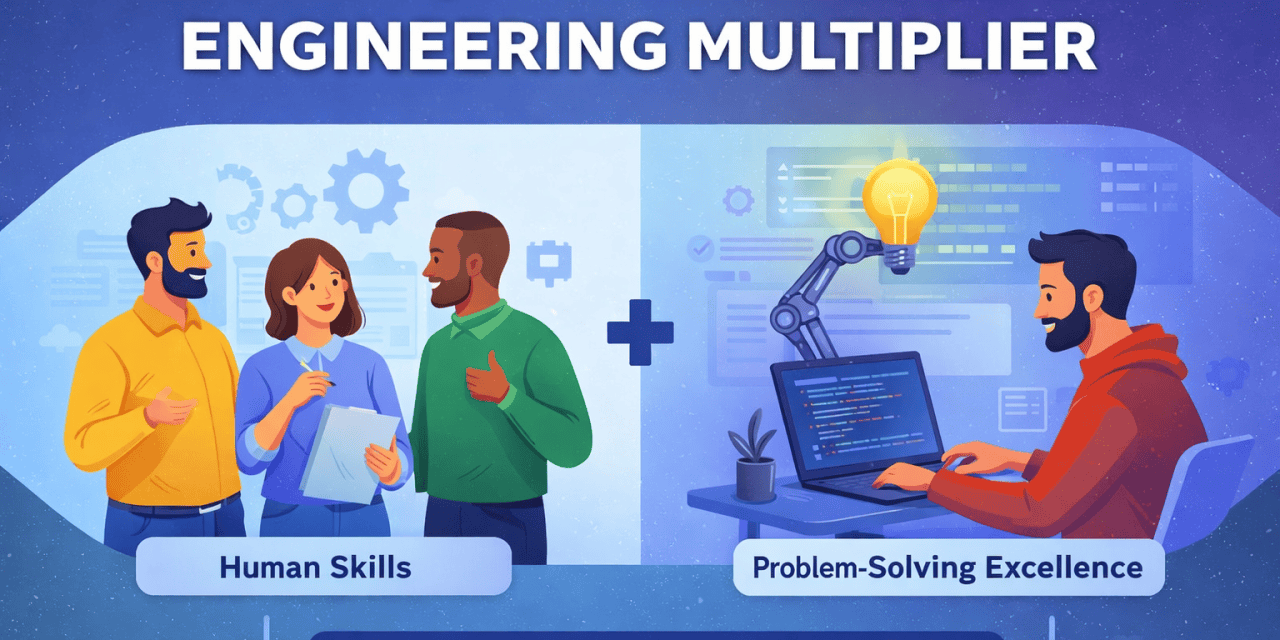
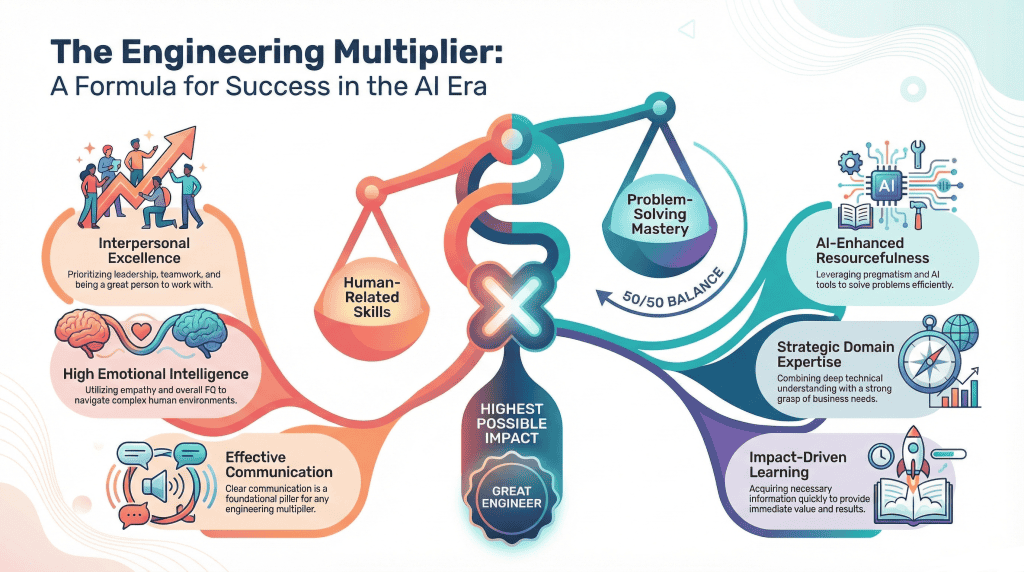
Engineering Multiplier = Human-related skills + Problem-solving excellence
…and the result is: learning/getting everything you need and providing impact.
Not “knowing everything.”
Not “being the smartest person.”
But consistently getting the right context, alignment, tools, and decisions—then turning that into results.
This post is our empowerment guide: what it means, what it looks like, and how you can build it step-by-step.
focuslogic Engineering Multiplier
Why “good coding” isn’t enough anymore
Let’s be honest: most projects don’t fail because the team can’t code.
They fail because:
- requirements stayed unclear
- scope changed without alignment
- communication broke mid-way
- bugs were discovered late
- production surprises happened
- decisions were delayed
- accountability was weak
AI reduces typing time. It doesn’t reduce the need for:
- ownership
- judgment
- empathy
- clarity
- verification
So at Focuslogic IT Services, we don’t want people who only “finish tasks.”
We want people who reduce confusion and increase outcomes.
That is an Engineering Multiplier.
What is an Engineering Multiplier (plain language)
An Engineering Multiplier is someone who makes the team stronger by default.
When they join a project:
- work becomes clearer
- blockers reduce
- quality improves
- delivery becomes more predictable
- teammates feel supported, not stressed
They don’t just “do their part.”
They raise the whole system: code, process, communication, and outcomes.
Pillar 1: Human-related skills (the real force multiplier)
“Soft skills” is a weak name. These are performance skills.
Leadership (even without a title)
Leadership here is not authority. It’s ownership.
Multipliers naturally say:
- “I’ll take the first pass and propose a direction by EOD.”
- “Let me summarize the decision so we don’t reopen it next week.”
- “Here are two options + tradeoffs. I recommend X.”
Leadership = making the next step obvious.
Teamwork (throughput over ego)
Multipliers don’t hoard knowledge or “important work.”
They unblock others.
This looks like:
- pairing for 20 minutes on the hardest part
- reviewing PRs quickly with clarity
- sharing context proactively
- helping debug and isolating root causes
Teamwork isn’t charity. It’s how we scale.
Communication (clarity is speed)
Clear communication isn’t long messages. It’s useful messages.
A strong update answers:
- What changed?
- Why?
- What’s next?
- What’s blocked?
- What risks remain?
For .NET/backend engineers, this also means:
- PR descriptions that explain intent + how to test
- API notes that mention compatibility/versioning/error handling
- small docs like: “how to run locally,” “how to validate,” “rollback plan”
Being easy to work with (underrated superpower)
This doesn’t mean you agree with everyone.
It means you disagree professionally.
Use phrases like:
- “I might be missing context—help me understand the constraint.”
- “I don’t think this scales because… here’s an alternative.”
- “Let’s test the assumption with a small spike.”
No PR wars. No ego battles. Just progress.
Empathy + emotional intelligence (trust is speed)
Software is built by humans under pressure.
Multipliers reduce stress by:
- noticing when someone is stuck
- communicating risks early (no surprises)
- protecting focus time
- giving feedback without humiliation
Trust increases speed. Empathy builds trust.
Pillar 2: Problem-solving excellence (real-world mastery)
This is not about interview puzzles.
It’s about solving messy problems under constraints.
Pragmatism (ship the right thing safely)
Multipliers ask:
- “What’s the simplest thing that solves the real need?”
- “What do we ship first to validate?”
- “What’s the risk if we’re wrong?”
In our .NET systems, pragmatism often means:
- fix the slow SQL query before rewriting the entire module
- use built-in platform features before inventing frameworks
- avoid clever abstractions that increase future maintenance cost
Resourcefulness (options > excuses)
Multipliers don’t stop at “blocked.”
They create options:
- minimal reproduction
- better logs and tracing
- isolating a failing dependency
- proposing a temporary workaround with rollback
AI leverage (speed + verification)
We encourage AI for:
- scaffolding code
- generating tests
- drafting docs
- summarizing logs
- exploring architecture tradeoffs
- refactoring ideas
We do NOT encourage:
- copy-paste code you can’t explain
- shipping without verification
- using AI as a replacement for thinking
Rule: If you can’t explain it, you can’t ship it.
Business understanding (impact over output)
Output is not our goal. Impact is.
Multipliers ask:
- “What pain are we removing?”
- “What does success look like for the client?”
- “What happens if this fails in production?”
Deep domain understanding (build what works here)
Domain knowledge prevents expensive mistakes:
- wrong validation rules
- broken reporting
- inconsistent states
- “works in dev, fails in real use”
Where AI amplifies—and where it doesn’t
AI amplifies multipliers
Because multipliers already practice:
- clarity
- verification
- ownership
- communication
Our recommended workflow:
- Define problem in one sentence
- List constraints (security, performance, rollout risk)
- Ask AI for options + tradeoffs
- Draft solution + tests
- Verify (run, test edge cases, confirm assumptions)
- PR notes: what/why/how-to-test/risk/rollback
AI speeds steps 3–4.
You own steps 1–2 and 5–6.
Signals: how to spot a multiplier on our team
High-signal behaviors we value
- clarifies requirements before coding
- summarizes decisions so they don’t repeat
- communicates risks early
- creates reviewable PRs with tests
- unblocks others (pairing/review/context)
- uses AI fast but verifies everything
- improves systems (docs, templates, automation, observability)
Warning behaviors we must eliminate
- “Just tell me what to do” mindset
- ego-driven review battles
- poor communication → confusion + churn
- cargo-cult AI copy/paste
- speed that creates instability
30-day empowerment plan (Focuslogic standard)
Week 1: Clarity + communication
Daily:
- 3 lines: Done / Next / Blocked
- before coding: Problem / Constraints / Expected outcome
- ask 2 clarifying questions for ambiguous tasks
- PR includes: why + how to test + risk
Deliverable: 1-page design note for your current feature
Week 2: Pragmatic problem solving
Daily:
- list 2 approaches + tradeoffs before building
- smallest safe change mindset
- improve one observability item daily (logs/errors/metrics)
Deliverable: propose fix for one recurring support pain
Week 3: AI leverage with verification
Daily:
- AI for tests/docs/options—not blind answers
- verify everything locally
- build a mini prompt library for your work
Deliverable: one complete AI-assisted PR with strong tests
Week 4: Multiply others
Daily:
- unblock 1 teammate (review/pair/context)
- improve 1 shared asset (README/template/checklist/script)
- share 1 learning (short note or demo)
Deliverable: 20-min session: “What I learned this month”
Common traps (and how we avoid them)
- Tool-only engineer: knows tools but impact stays same → tie tools to outcomes
- Ego: people avoid working with you → replace certainty with curiosity
- Poor communication creates churn → write short decision notes + clear PRs
- Cargo-cult AI: ships unknown code → explain → test → verify → ship
Conclusion: our internal standard
At Focuslogic IT Services, we build software customers depend on.
So we need engineers who don’t just write code—we need engineers who multiply impact.
Engineering Multiplier = Human skills + Problem-solving excellence
Result: getting what you need and delivering impact.
Call to action: pick ONE multiplier habit and practice it this week.
When each person improves by 1%, the company improves by 10x.




Recent Comments